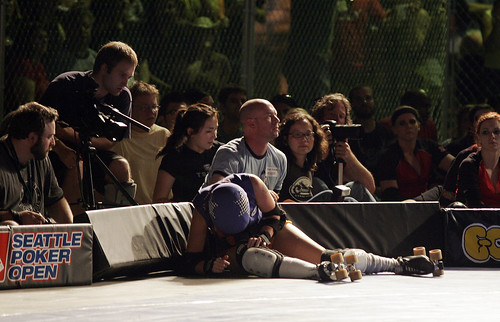
So I was thinking the other day about skater safety and bouts vs. scrimmages. There is an assumption (at least on my league) that bouts are inherently more dangerous than scrimmages. As a result, skaters are allowed to participate in scrimmages for a very long time before they are put onto a team and allowed to bout. As a scientist, I wondered if there is any actual data to support this assumption. As an unteamed skater, I secretly believe they can't be that different, and hoped to find some data to support that. I also don't want to work on my thesis, so I spent a good deal of time this morning researching the subject. I didn't really expect to find any data for roller derby, but I thought perhaps there would be something for other sports. I found a few studies that sort of got at the issue, but not very well. I also posted a message to the rollerderbystatsgeeks yahoo group asking if anyone kept track of injury statistics. Very few leagues did (we don't either) but what really surprised me was how little value people seemed to think the idea had. So I wrote up this little post about how keeping track of injury statistics could be useful. The real question is, why can't I be this productive writing my thesis?
****************************************************
I think there are five general ways in which injury statistics can be useful. 1) They can highlight areas that you might not be aware of, 2) they can help improve bout success, 3) they can dispel previously held assumptions, 4) they can be part of your arsenal when dealing with skaters or outside parties, and 5) in the long term, they can be used to help shape decisions about the direction of the sport.
Highlighting problem areas
Keeping track of injury stats can highlight problem areas in your training. For instance, are skaters more likely to be injured:
If the data shows one of these trends, you can use that information to make changes to your training regimen or setup. If one drill is more dangerous than others, maybe it’s time to re-jig or remove it. If there is an upswing in certain types of injuries, you might want to change your training to emphasize drills that would prevent those injuries (more emphasis on falling drills, for instance, or stretching or strength training). It’s one thing to think that you really ought to be stretching more (or whatever). It’s another thing to see the facts and know that people are being injured because you’re not stretching enough. If one venue is more dangerous than another, maybe you should be putting more effort into finding a new one or at least taking steps to increase the safety of that venue. If skaters are more likely to be injured while wearing certain equipment or a certain brand, that would be a pretty good reason to change the equipment. Having this information from other leagues could help you make these changes before injuries occur.
Of course, you also have to look at the reasons behind the results. For instance, there could be many reasons why girls are more likely to be injured before being teamed (this is just a hypothetical example – I have no idea if it is true). Perhaps they are simply less experienced or have less overall fitness. Perhaps they are trying too hard to impress the coaches, taking unnecessary chances or pushing themselves when they are ill or hurt. Maybe the injuries are occurring when they are practicing on their own without the support of a team. Maybe they just didn’t know enough to put their skates on the right way or have the right safety equipment. Knowing why something is the way it is would help you make the right response and increase the safety of your skaters.
Improving bout success
During bouts, you could find out if skaters are more likely to be injured
Dispelling assumptions
There are a lot of assumptions out there about safety and roller derby. For example: Less experienced skaters are more likely to get hurt (or to cause others to be hurt); Bouts are more dangerous than scrimmages, which are more dangerous than full contact practices, which are more dangerous than non-contact practices. Leagues make decisions based on these assumptions. For instance, on our league, un-teamed skaters are not allowed to participate in bouts, but are allowed to participate in scrimmages. The assumption is that bouts are more dangerous than scrimmages. But there is no actual data to support that assumption. Having that data could bolster a league’s policy or allow them to reconsider it.
The results of your analysis may not be what you expect. For instance, a study of inline skating injuries from 1999 showed that 55% of injured skaters classified themselves as Intermediate or Advanced (compared to 45% who classified themselves as Novice or Beginner). This doesn’t necessarily have any relation to roller derby, but the point remains that the assumption that more experienced skaters are less likely to be injured doesn’t necessarily hold true. Another study looking at injuries in Big Ten football showed that there were relatively more injuries during spring scrimmages than during the spring game. Again, this doesn’t necessarily have anything to do with roller derby, but the fact is that there is no data for roller derby. (I can provide the citations for these studies if anyone wants them)
Increasing your arsenal
Roller derby is often perceived as a violent and dangerous sport. This can be appealing to some folks but not to others. Owners of potential venues or practice spaces, possible sponsors, or insurance companies, for instance, might be put off by the threat of major injuries. Having solid statistics about injuries (both for your league and for roller derby as a whole) can help put their minds at ease. It also shows that roller derby is a serious, organized sport that is taking safety seriously and is taking steps to keep their skaters safe. This makes you more appealing as an organization to be dealt with.
Shaping the direction of the sport
In the long term, injury statistics can be used to help make decisions about the direction of the sport as a whole. These sorts of statistics have been used in the past to change equipment requirements and rules for many sports. Why not roller derby?
Of course, you also have to look at the reasons behind the results. For instance, there could be many reasons why girls are more likely to be injured before being teamed (this is just a hypothetical example – I have no idea if it is true). Perhaps they are simply less experienced or have less overall fitness. Perhaps they are trying too hard to impress the coaches, taking unnecessary chances or pushing themselves when they are ill or hurt. Maybe the injuries are occurring when they are practicing on their own without the support of a team. Maybe they just didn’t know enough to put their skates on the right way or have the right safety equipment. Knowing why something is the way it is would help you make the right response and increase the safety of your skaters.
Improving bout success
During bouts, you could find out if skaters are more likely to be injured
- During their first bout? Or the first bout of the season?
- During a bout than a scrimmage?
- When there are more or less refs?
- During a 30 minute period vs. a 20 minute period?
- If your team (or the other team) is acquiring a lot of penalties?
- If it is a high scoring bout or a low scoring bout?
- If skaters skate in two bouts in a row during a double header?
- If they skate more than a certain number of minutes during the period?
- If they are skating with new members of their team?
Dispelling assumptions
There are a lot of assumptions out there about safety and roller derby. For example: Less experienced skaters are more likely to get hurt (or to cause others to be hurt); Bouts are more dangerous than scrimmages, which are more dangerous than full contact practices, which are more dangerous than non-contact practices. Leagues make decisions based on these assumptions. For instance, on our league, un-teamed skaters are not allowed to participate in bouts, but are allowed to participate in scrimmages. The assumption is that bouts are more dangerous than scrimmages. But there is no actual data to support that assumption. Having that data could bolster a league’s policy or allow them to reconsider it.
The results of your analysis may not be what you expect. For instance, a study of inline skating injuries from 1999 showed that 55% of injured skaters classified themselves as Intermediate or Advanced (compared to 45% who classified themselves as Novice or Beginner). This doesn’t necessarily have any relation to roller derby, but the point remains that the assumption that more experienced skaters are less likely to be injured doesn’t necessarily hold true. Another study looking at injuries in Big Ten football showed that there were relatively more injuries during spring scrimmages than during the spring game. Again, this doesn’t necessarily have anything to do with roller derby, but the fact is that there is no data for roller derby. (I can provide the citations for these studies if anyone wants them)
Increasing your arsenal
Roller derby is often perceived as a violent and dangerous sport. This can be appealing to some folks but not to others. Owners of potential venues or practice spaces, possible sponsors, or insurance companies, for instance, might be put off by the threat of major injuries. Having solid statistics about injuries (both for your league and for roller derby as a whole) can help put their minds at ease. It also shows that roller derby is a serious, organized sport that is taking safety seriously and is taking steps to keep their skaters safe. This makes you more appealing as an organization to be dealt with.
Shaping the direction of the sport
In the long term, injury statistics can be used to help make decisions about the direction of the sport as a whole. These sorts of statistics have been used in the past to change equipment requirements and rules for many sports. Why not roller derby?