Monday, April 7, 2008

Roller Derby Videos on the web

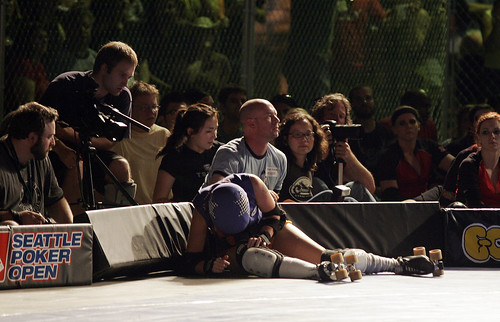
Roller Derby HowTo: How to conduct a chair fight on skates. Video forthcoming.

A couple of quick links to some new roller derby video resources. It's amazing how many sites have cropped up that didn't exist when I started roller derby not that long ago. Here are a couple of sites I have recently discovered:

Expert Village has a series of videos on YouTube about roller derby basics -- skating posture, blocking, how to choose roller skates, etc. I distinctly remember deciding to purchase some skates before trying out for roller derby (a crazy extravagance considering I'd been to all of two bouts and could barely skate without falling at the time) and realizing that I didn't even know if I should be looking at those skates with the tall boots that looked like ice skates or those skates with the low boot that looked more like sneakers. I'd been to several bouts but never thought to look. I waited until the next bout and tried to surreptitiously check out what the girls were wearing without looking like an idiot. I could have used some of these videos.

Expert Village also has a series of videos (which is on their main site but not on their YouTube site for some reason) called How to Start a Roller Derby Team. This series is narrated by Jerry Seltzer, son of Leo Seltzer, the man who created roller derby back in the day. I haven't actually watched these videos but they look great and include some great how-tos like How to hold tryouts, How to promote roller derby events and How to book roller derby arenas. These are nice because they recognize that new leagues need advice just as much as new skaters.

Roller Sport TV has a small (but quickly growing) collection of bout videos.

Via Derby has a video site called Real to Reel with a nice collection of videos. I am especially fond of the video explaining how to clean your bearings. I also could have used that the first time I cleaned my bearings (only a few months ago!) with no freakin' idea what I was doing.

MavTV has full bout coverage from Heartland Havoc and Texas Shootout. Check out the round 1 thriller between Boston and Detroit. It totally rocks!

And don't forget the Boston Derby Dames YouTube group, which is a collection of everything BDD related on YouTube. If that's too chaotic for you, try my YouTube channel playlists, which has all the same videos, but nicely organized into categories (I can't help it -- I'm a taxonomist).

Cheers!

Friday, April 4, 2008

B. Good video -- We're really very nice people


On Monday night a gang of Derby Dames descended on B. Good's Brookline location to wreak havoc and have their way with the place. I am happy to report that I was one of the gang, which also included Sheryl Crowbar, Frances of Assassin, Maude Forbid, Triple Deck-Her, Wynonna Thudd, Varga Bomber, and Etta Maims. A video was shot to promote their new salad, the Hatchback (which I am also happy to report is named after a guinea pig). A good time was had by all. I think I had the best part, though, cause I got to throw a hamburger at the wall, and didn't even have to clean it up afterwards. Please note the pickle, which embedded itself into the wall and never made it to the ground, poor thing. Fun fun fun.

B. Good video
Photos from event

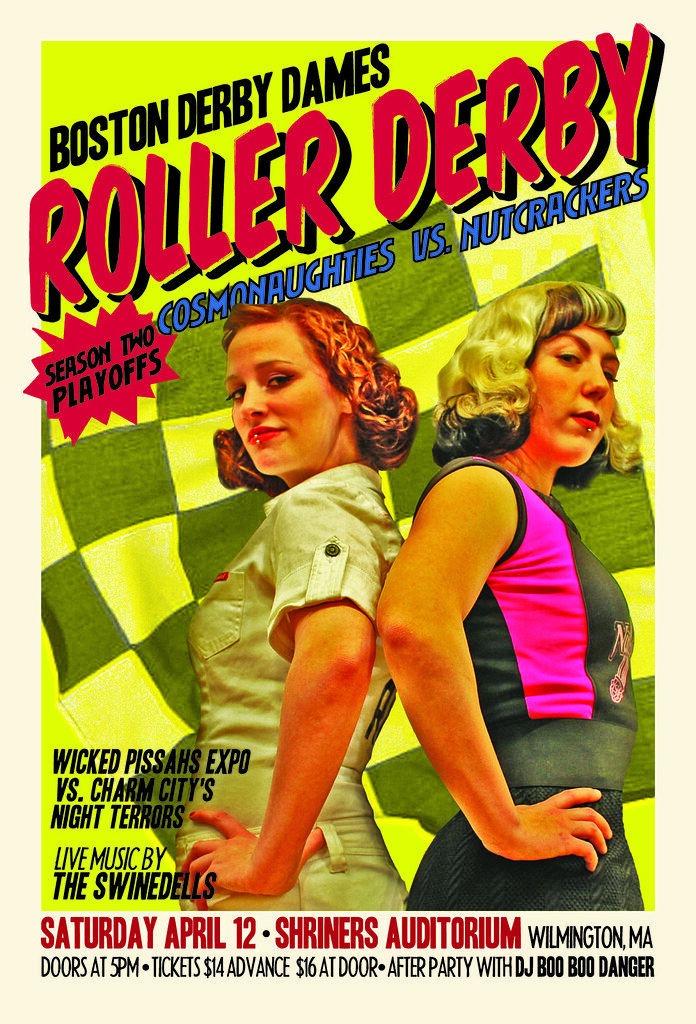
Season 2 Playoffs and Toy Drive!! April 12

Season Two Playoffs!
Nutcrackers vs Cosmonaughties
Wicked Pissah Expo vs Charm City Rollergirls' Night Terrors (from Baltimore)
Music by The Swinedells
Toy Drive to benefit Children's Hospital Boston

Saturday, April 12
Doors at 5 pm, Bout at 6 pm
Tickets $14 in advance, $16 at the door

Delinquent Dames in a mad race to capture the title! The Nutcrackers' dance school dropouts take on the Cosmonaughties, BDD's resident Reds, for the chance to yank the Championship crown from the Wicked Pissahs teased tresses.

The Nutcrackers found themselves stuck in neutral against Wicked Pissahs in the first bout of Season Two and suffered an ignoble 142-41 defeat, but rallied to speed past the Cosmonaughties 69-42 in their next outing. When it was the Cosmo's turn to take the line against the Pissahs, they brought high octane derby energy, but still fell victim to townie teamwork with a 103-64 loss.

Now the Nuts and Cosmos are revving their engines, greasing their wheels, and sharpening their nails as they prepare for a match-up that will send one team to the championship and one team back to detention.

With hell-on-wheels jammers like Sarah Doom and Baby Fighterfly, and hard hitters like two-time MVP Quick Sandy, the Nuts can taste the super unleaded tang of victory. But with the mighty whomp of Cosmo blockers Anna Wrecksya and Pussy Venom, and the all-around awesomeness of Tiny Twins Claire D. Way and Maura Buse, the Nuts might end up with little more than a mouthful of space dust.

Not content to sit back and watch, the Wicked Pissahs (whose undefeated record gives them a bye for the championships) have invited the Night Terrors from Baltimore's Charm City Rollergirls for an expo bout to kick the night off.

Halftime music by Boston's own Swinedells:
  • 1 part R&B
  • 1 part Rockabilly
  • 1 part 50's Rock and Roll
  • 1 part punk rawk
  • 6 drunken buffoons
  • a dollop of pomade
Combine ingredients with a washtub full of Miller High Life and set it in the garage till it starts to stink.

The legendary Fez Room after party action continues, with DJ Boo Boo Danger keeping the dance floor hot and sweaty until midnight.


Toy Drive for Children's Hospital Boston

We're trying to help fill the wishlist of the kids and staff on the 10th floor, the Surgical Transplants and Implants department. The items on this list are things that the children use on a daily basis. All the items are cleaned and sterilized after each use, which really shortens a toys life.

Drop off new and gently used, clean toys at the merch table and receive a BDD sticker, plus our sincere thanks. We'll be making a donation in person, and invite you to sign a card to the kids from all of us.

Kids' scissors
Playdough
Bubbles
Markers
Crayons
Play trains
Dumbo infant seat
Globe
Mobiles
Chinese checkers
Mancala
Band in a Box kid's musical instrument set
Chunky puzzles
Rattles
Board books
Little People for farm, circus, etc.
Young adult movies
Books with interactive buttons/music
Yarn
Colorforms
Wii (Mario Brothers)
Guitar Hero
New strollers to push infants and toddlers around the hospital
Baby swing
Beads and elastic
Flat screen TV
PS2 systems (There are 24 rooms with only 15 furnished with PS2 systems, which leaves 9 to reach their goal; BDD's refs have already secured donations of 3 PS2s!)
PS2 games

Monday, March 31, 2008

Making Injury Stats Happen

Here is a comment that Dreadnought left on my last post about injury stats:
I definitely see how seeing the numbers over time would help. However, I wonder how it could be put into practice. Would a simple form for each injury be be enough (date, type of activity, type of drill, coach name, etc.) and how minor an injury would need to be considered? I would imagine that doing this well would be a bit of an undertaking, so I would imagine that the next logical step would be to consider the "hows" after thoroughly canvasing the "why's".
I like the way you think! So, just off the top of my head, here is one way that this could be carried out.
  • Make a blank form that can be easily photocopied and keep a bunch of them in your coaching bag or wherever it will always be at your practices/bouts/events
  • Come up with some sort of rule about when to record an injury. This can be tricky because what seems like a minor injury at practice may turn out to be something more serious and skaters sometimes don't want to make a big deal. If you have a rule, then you're never in a situation where you are asking the skater to tell you whether the injury is serious or not. I suggest recording any injury that takes a skater out of a drill or jam, that requires ice, or that involves blood.
  • I also suggest making sure it is clear who is in charge of recording this info. The coach might be a good start, but coaches are often super busy during practices and may not have the time to do this. Maybe an assistant coach, a manager, or whoever wants to be in charge.
  • You could have the form only be filled out when there is an injury. This is clearly more convenient (and easier to convince people to do). It would be better, however, if data was collected for every practice, even those when no injuries occur. This would insure consistency in your records. If someone has to sit down after every practice and spend 15 seconds checking a box that says "no injuries," then there will be less of a chance for injuries to be missed when practice runs late and everyone has to run out the door afterwards. And it is much more convincing evidence if there is ever a problem with insurance or what-have-you.
  • Follow-up is also important. Include something on your form that has to be filled out a week later (or whatever) to check-in with your skater and make sure you've recorded the outcome (thus far). Did they see a doctor? Did it get worse later on? Are they missing practice because of it? Do they have any restrictions? This is the sort of thing that a good coach would ask about anyway, but having a record of it will come in handy later on (when you might have forgotten the specifics). For instance, if the skater needs to fill out some form for their health insurance, they can go back to that record and get the details that may have been forgotten.
That's about it. I was going to try and make up a sample form that people could use, but it's taking too long and I thought it would be better to just post this first.

While I was meandering my way through the internet, I found a website that sells some kind of sports injury management software to keep track of this sort of thing. And they had a very nice summary of why keeping track of injury statistics can be helpful, basically saying the same things I said in my last post, but a little more concisely:

  • Provide information about the nature and amount of injury within a sport
  • Identify those sub populations competing who are at greater risk of injury e.g. different playing positions may have differing risks for certain injuries
  • Produce information to allow for the planning of resources needed to manage and treat Sports injuries
  • Evaluate risk factors for injury
  • Show the differences in injury incidence and injury severity for a variety of different sub sets of the athletic population
  • Allow a Governing body to demonstrate their commitment to participant safety by monitoring and analysing the injuries encountered
  • Be used as a starting point for a more system tailored to a specific situation. For example looking at the effect, playing surface has on injury incidence for the same athlete exposure.
A specific SIS system can
  • Look at the impact of athletic equipment on injury incidence / prevalence and or severity.

E.g. the impact of different shoe wear on running injury
The impact of ankle braces on ankle injury etc

  • Examine the effect of different playing maneuvers on injury incidence e.g. spear tackling now banned in American Football following an injury surveillance program
  • Provide information to implement injury prevention strategies aimed to improve participant safety but not reduce sporting enjoyment
  • Give a closer understanding of the etiological factors responsible for changes in incidence and prevalence of injury providing controls are in place
  • Allow guidelines of good practice to be generated improving athletic injury management
  • Evaluate economic results of athletic injury
  • Direct costs = (cost of x-ray specialist time operations etc)
  • Indirect Costs = Expenditure incurred due to loss of productivity (5 fewer goals scored during season) or athlete now at potentially greater risk of re injury (less time spent competing)
  • Be tailored to any particular user requirements providing adequate controls can be put in place

Walk for Change

On April 6, the Boston Derby Dames will be participating in the Walk for Change to benefit the Boston Area Rape Crisis Center. We will be LEADING THE WALK this year, which is a huge honor. I'm not sure I have walked for anything since I walked for the whales in seventh grade! You can support us (and BARCC) by donating or walking with us! Visit my fundraising page and help me make it look a little less sad (so far I have raised zero dollars).

Slugs and Kisses,
~Mayhem


Saturday, March 29, 2008

Positions - How to play them

Punchy O'Guts of Maine Roller Derby has a blog which I just discovered. I found this old post about player positions which I found very helpful. Plus she has a cool roller derby photo, which I secretly yearn for.

PIVOT - paces the pack, knows when to slow or speed up in regards to jammer positions.
1. Always help your jammer. If you are in the very front of the pack give her a whip. If you can't whip her, push her. She needs all the momentum she can get to make it back around. If you're a little behind and can't reach her, speed up to give her that push - you can slow down and rest for a minute in the pack, whereas she cannot.
2. Push the opposing jammer out and around you. She won't score on you if you push her out of bounds and let her skate in front of you. You've protected you're point and not wasted too much energy.

INSIDE (I don't play this often, so I know very little.)
1. Look around. Always. You must know when to hold the line and when to move for your jammer.
2. Push opposing inside player off the line to make a hole for your jammer - keeping in mind where the opposing jammer is.
3. If your skate isn't holding the line, make sure your butt is.
4. Play cat & mouse. Open the inside line while the opposing jammer is about three feet behind you. She'll quicken her stride to get through and you can close the gap and push her inside and out of bounds and around you. She won't score on you and you protect your point.

OUTSIDE - Works with pivot and covers outside of pack.
1. If you can skate up with your pivot and build a wall, do it. But don't at your jammers expense.
2. If your pivot is chasing down the jammer, make sure you skate 9 feet in front of the pack to give her more time to catch the jammer. Also call your pivot back once she's about to engage out of bounds.
3. If not up front with your pivot. Move inside the pack to push opposing blockers toward the outside for you jammer to get through on the inside - always ready to block opposing jammer is she chooses the path you made for your jammer.

BACK - skates in the back of the pack. main communicator.
1. Because you are in the back. You can see everyone and communicate to your players where everyone is. TALK! Delegate where your blockers should go to create a path for your jammer. Delegate where blockers should go to hit the opposing jammer.
2. Once the jammers have passed you. Skate up to opposing blockers and push them into other blockers or the jammer. You have the most advantage in the back because you can see everyone. Don't forget it!
3. As the opposing jammer approaches, keep an eye on her and booty block her. It slows her down, distracts her, and kills all momentum - physically and mentally.
4. If you're jammer is through, replacement block. Get up there and take out the opposing jammer.

JAMMER - (I am not experienced in this position, but have found a couple things that work to my advantage.)
1. Instead of plowing through the pack and getting penalties for back-blocking and cutting the track, allow the other jammer to go through first. Being patient gives you a chance to watch the pack move to either help or hit the opposing jammer. Most often a hole is created. (The disadvantage is that by holding back a little you may be giving up lead jammer status.)
2. Hit your way through. HIT 'EM! You can make your own holes. Get low and hit shoulder to thigh to push opposing blockers out of your way.
3. If you can hit the opposing jammer, do it! It gives you time to clear the pack, earning four points and calling it off before she can earn another four points.

Wednesday, March 19, 2008

How injury statistics can help prevent injuries


So I was thinking the other day about skater safety and bouts vs. scrimmages. There is an assumption (at least on my league) that bouts are inherently more dangerous than scrimmages. As a result, skaters are allowed to participate in scrimmages for a very long time before they are put onto a team and allowed to bout. As a scientist, I wondered if there is any actual data to support this assumption. As an unteamed skater, I secretly believe they can't be that different, and hoped to find some data to support that. I also don't want to work on my thesis, so I spent a good deal of time this morning researching the subject. I didn't really expect to find any data for roller derby, but I thought perhaps there would be something for other sports. I found a few studies that sort of got at the issue, but not very well. I also posted a message to the rollerderbystatsgeeks yahoo group asking if anyone kept track of injury statistics. Very few leagues did (we don't either) but what really surprised me was how little value people seemed to think the idea had. So I wrote up this little post about how keeping track of injury statistics could be useful. The real question is, why can't I be this productive writing my thesis?

****************************************************

I think there are five general ways in which injury statistics can be useful. 1) They can highlight areas that you might not be aware of, 2) they can help improve bout success, 3) they can dispel previously held assumptions, 4) they can be part of your arsenal when dealing with skaters or outside parties, and 5) in the long term, they can be used to help shape decisions about the direction of the sport.

Highlighting problem areas

Keeping track of injury stats can highlight problem areas in your training. For instance, are skaters more likely to be injured:

  • When one person is coaching?
  • During a particular drill?
  • On one floor surface over another?
  • At one venue over another?
  • While wearing certain equipment or clothing?
  • During a certain period of training?
  • When returning from a leave of absence?
  • Before or after assessments?
  • Before or after being teamed?
  • To skaters of certain experience levels?
  • On one particular team?
  • During certain types of practice?
  • Off skates vs. on skates?
  • Contact vs. non-contact or partial contact?
  • Scrimmages

  • If the data shows one of these trends, you can use that information to make changes to your training regimen or setup. If one drill is more dangerous than others, maybe it’s time to re-jig or remove it. If there is an upswing in certain types of injuries, you might want to change your training to emphasize drills that would prevent those injuries (more emphasis on falling drills, for instance, or stretching or strength training). It’s one thing to think that you really ought to be stretching more (or whatever). It’s another thing to see the facts and know that people are being injured because you’re not stretching enough. If one venue is more dangerous than another, maybe you should be putting more effort into finding a new one or at least taking steps to increase the safety of that venue. If skaters are more likely to be injured while wearing certain equipment or a certain brand, that would be a pretty good reason to change the equipment. Having this information from other leagues could help you make these changes before injuries occur.

    Of course, you also have to look at the reasons behind the results. For instance, there could be many reasons why girls are more likely to be injured before being teamed (this is just a hypothetical example – I have no idea if it is true). Perhaps they are simply less experienced or have less overall fitness. Perhaps they are trying too hard to impress the coaches, taking unnecessary chances or pushing themselves when they are ill or hurt. Maybe the injuries are occurring when they are practicing on their own without the support of a team. Maybe they just didn’t know enough to put their skates on the right way or have the right safety equipment. Knowing why something is the way it is would help you make the right response and increase the safety of your skaters.

    Improving bout success

    During bouts, you could find out if skaters are more likely to be injured
    • During their first bout? Or the first bout of the season?
    • During a bout than a scrimmage?
    • When there are more or less refs?
    • During a 30 minute period vs. a 20 minute period?
    • If your team (or the other team) is acquiring a lot of penalties?
    • If it is a high scoring bout or a low scoring bout?
    • If skaters skate in two bouts in a row during a double header?
    • If they skate more than a certain number of minutes during the period?
    • If they are skating with new members of their team?
    Having this data can help you make decisions about how you structure and organize bouts and lineups. This will not only increase the safety of your skaters but the success of your bouts!

    Dispelling assumptions

    There are a lot of assumptions out there about safety and roller derby. For example: Less experienced skaters are more likely to get hurt (or to cause others to be hurt); Bouts are more dangerous than scrimmages, which are more dangerous than full contact practices, which are more dangerous than non-contact practices. Leagues make decisions based on these assumptions. For instance, on our league, un-teamed skaters are not allowed to participate in bouts, but are allowed to participate in scrimmages. The assumption is that bouts are more dangerous than scrimmages. But there is no actual data to support that assumption. Having that data could bolster a league’s policy or allow them to reconsider it.

    The results of your analysis may not be what you expect. For instance, a study of inline skating injuries from 1999 showed that 55% of injured skaters classified themselves as Intermediate or Advanced (compared to 45% who classified themselves as Novice or Beginner). This doesn’t necessarily have any relation to roller derby, but the point remains that the assumption that more experienced skaters are less likely to be injured doesn’t necessarily hold true. Another study looking at injuries in Big Ten football showed that there were relatively more injuries during spring scrimmages than during the spring game. Again, this doesn’t necessarily have anything to do with roller derby, but the fact is that there is no data for roller derby. (I can provide the citations for these studies if anyone wants them)

    Increasing your arsenal

    Roller derby is often perceived as a violent and dangerous sport. This can be appealing to some folks but not to others. Owners of potential venues or practice spaces, possible sponsors, or insurance companies, for instance, might be put off by the threat of major injuries. Having solid statistics about injuries (both for your league and for roller derby as a whole) can help put their minds at ease. It also shows that roller derby is a serious, organized sport that is taking safety seriously and is taking steps to keep their skaters safe. This makes you more appealing as an organization to be dealt with.

    Shaping the direction of the sport

    In the long term, injury statistics can be used to help make decisions about the direction of the sport as a whole. These sorts of statistics have been used in the past to change equipment requirements and rules for many sports. Why not roller derby?